

Patent Law INTERNATIONAL
How do you best keep an up-to-date overview of international patent law? Simple: with the first English-language module Patent Law INTERNATIONAL you will have everything you need at your fingertips to quickly find practical guidance to overcome any challenge efficiently and successfully.
This new online module offers a comprehensive collection of English-language commentaries and handbooks on international patent law, including the journals GRUR International and International Review of Intellectual Property and Competition Law (IIC).
A particular highlight is the new BeckOK Unified Patent Court. Written by a team of 60 renowned patent law experts, including numerous judges at the Unified Patent Court, this comprehensive commentary will ensure that you have the information required to navigate through EU substantive and procedural patent law.


Commentaries and handbooks

Commentaries and handbooks


The new Beck Online Commentary on the Unified Patent Court (BeckOK UPC) provides a comprehensive, practice-oriented and continuously updated commentary on the new European Unitary Patent system. The Unified Patent Court is an internationally organized court with two instances that handles disputes related to the European patent and plays a central role for businesses throughout Europe.
The commentary covers the key legal frameworks surrounding the Unitary Patent and the Unified Patent Court, including:
- The Agreement on a Unified Patent Court (UPCA)
- The Rules of Procedure of the UPC (RoP)
- Regulation (EU) No 1257/2012 (on the implementation of enhanced cooperation in the area of the creation of unitary patent protection)
- Regulation (EU) No 1260/2012 (Translation Regulation implementing enhanced cooperation in the area of the creation of unitary patent protection as regards the applicable translation arrangements)
- Other relevant provisions (e.g. interpretative notes of the Administrative Committee)
The Council Regulation (EC) No 6/2002 of 12 December 2001 on Community designs establishes a system for obtaining a Community design that provides uniform protection with a uniform effect for the entire Community. This prevents identical designs from being protected differently in the various Member States and for the benefit of different owners, which would inevitably lead to conflicts in trade between Member States.
The importance of the Community design regulation cannot be overstated for practical applications.
This work provides a systematic commentary on the individual provisions of the Regulation as well as an exposition of the implementing provisions in the individual Member States of the European Union.
Benefits at a glance:
- practice-oriented
- expert perspective
- comprehensive presentation of European as well as national law
The new edition takes into account case law and literature up to July 2017.
Target audience: Specialists in the field of industrial property protection (lawyers, patent attorneys, legal departments).
The Regulation (EC) No. 207/2009 of the Council of 26 February 2009 on the Community trade mark has been amended several times and in essential respects in recent years. These fundamental amendments have now been codified in the new Regulation (EU) No. 2017/1001 of the European Parliament and of the Council of 14 June 2017. Its purpose is to ensure the smooth functioning of the internal market, which should provide conditions comparable to a national market. In order to realize such a market and strengthen its unity, legal conditions must also be created that enable companies to adapt their activities in the fields of production and distribution of goods and services to the scale of a common market. One of the particularly appropriate legal possibilities is the use of trade marks, which allow them to designate their goods or services throughout the Community regardless of borders.
This thoroughly revised 2nd edition provides a systematic commentary on the individual provisions of the new Regulation as well as an account of the implementing provisions in the individual Member States of the European Union.
Benefits at a glance:
- practice-oriented
- expert perspective
- comprehensive presentation of both European and national law
Target audience: Specialists in the field of industrial property protection (lawyers, patent attorneys, legal departments).
Planung, Gestaltung, Sonderformen, regulatorische Rahmenbedingungen und Streitbeilegung bei Mergers & Acquisitions: Jahrzehntelange Erfahrung im Transaktionsgeschäft finden Sie gebündelt in diesem Handbuch für den M&A-Professional. In 19 Großkapiteln und mehr als 100 Unterabschnitten behandelt dieses Handbuch alle Facetten des Transaktionsgeschäfts. Neue Entwicklungen, besondere Situationen – etwa M&A in Unternehmenskrisen – sowie Finanzierungsfragen erläutert das Werk ebenso wie branchenspezifische Besonderheiten, Verfahrensrecht, kartellrechtliche und steuerliche Aspekte. Internationale Bezüge werden entsprechend ihrer praktischen Bedeutung hergestellt.
- für Transaktionen im Mittelstand
- gründlich und praxisnah
- erfahrene, spezialisierte Autorinnen und Autoren
In this book, three experienced legal practitioners in patent matters provide a reliable and detailed guideline on how to enforce patents in three of the most important jurisdictions for patent infringement litigation, namely Germany, Japan and the United States. The book is structured by the relevant subject matters of patent litigation such as scope of patent protection, claims of the patent holder and objctions of the alleged infringer, fact finding, pre-procedural measures, trial, principles of procedure and comparative aspects.
The advantages at a glance:
- concise guide for practitioners in the field of patent litigation
- detailed references to legal provisions, academic writings and court decisions
- clear style of writing
The new edition includes up-to-date information on recent case law and legislative reforms.
The handbook is a valuable guide for legal practitioners, including companies and their legal counsel, for all relevant questions relating to patent litigation in Germany, Japan and the United States.
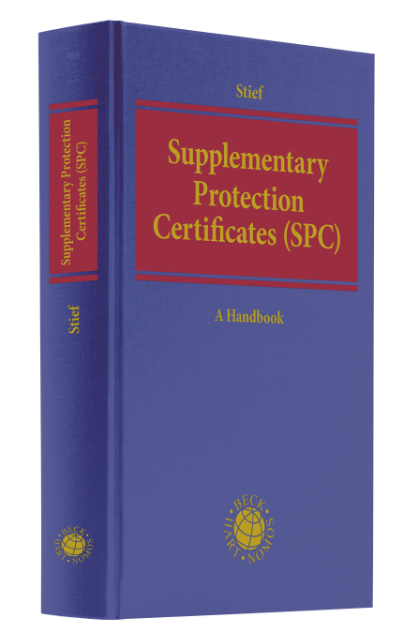
Supplementary protection certificates (SPC) extend the effects of patents for medicinal products by a maximum of five and a half years, i.e. the certificate becomes effective at a time when the respective pharmaceutical is widely known on the market and thus generates the maximum revenue. This explains the enormous economic value of SPCs. They protect some of the most valuable products in the pharmaceutical industry. The legal basis for the SPC for medicinal products is a European Regulation.
The obtaining provisions of that Regulation, the scope of protection etc. are highly disputed and have been the subject of numerous decisions of the CJEU. This handbook provides valuable insights into the world of SPCs and the most significant case law and legal sources at EU and national level of Germany, the UK, France, Italy, the Netherlands and Switzerland. The second completely revised edition specifically addresses recent developments of SPCs including manufacturing waivers and the implications of “Brexit”.
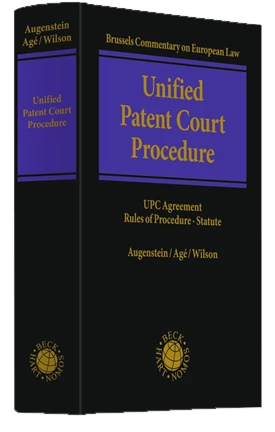
- includes UPC case law
- clear, structured approach
- comparative insights
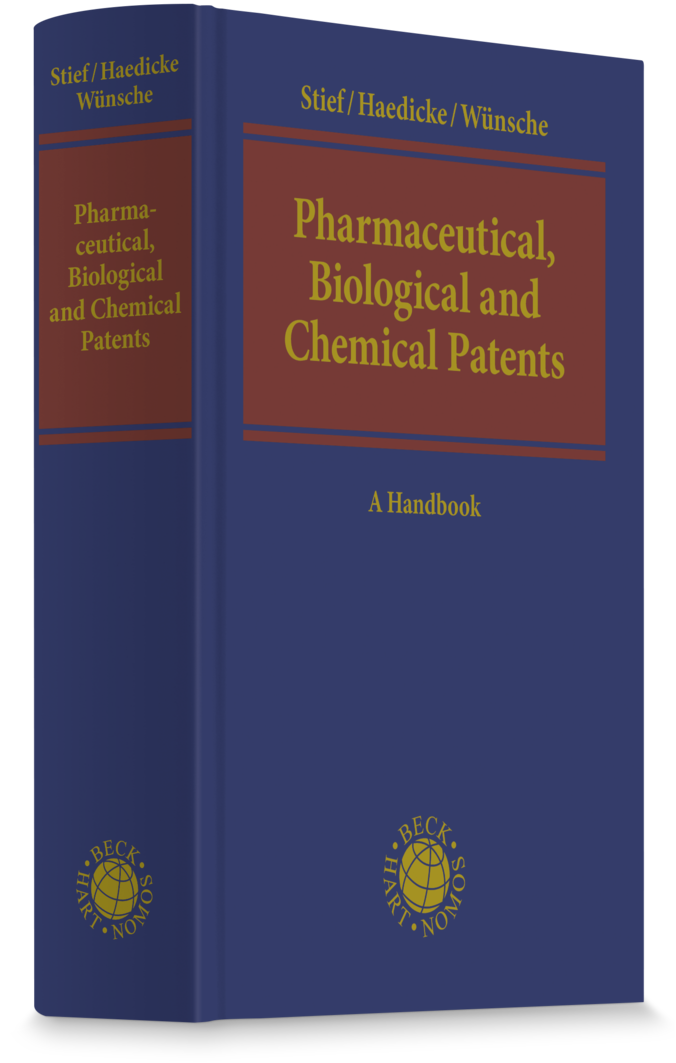
Germany is one of the world’s leading jurisdictions for patent litigation. In Europe alone, approx. 60 % of patent disputes are heard before courts in Germany. Answers to key questions in patent law and the possible interpretation thereof may be found in the rich array of case law from German courts. Pharmaceutical, biological and chemical patents are key matters in patent law. The fields present multiple challenges and source of legal disputes, especially in relation to matters of ‘state of the art’ and the different identifications of a substance and the resulting patents. German courts have given valuable insights to resolving globally significant issues. This handbook therefore focuses especially on German jurisprudence to identify key principles and trends, thereby providing valuable assistance and arguments in other jurisdictions.
- Structured explanations of German patent law
- Complete English translations of key German case law
- Tailored to central issues in pharmaceutical, biological and chemical patents

Patents on medical indications have gained enormous economic significance in recent decades. However, pharmaceutical development focuses less on new active ingredients and more on new therapeutic applications of known active ingredients. In this context, patents for reference medication may expire, but independently patents may exist for the utilisation. Many of the ‘blockbuster products' are protected by utilisation patents.
This approach has given rise to ‘skinny labelling', whereby generic medicines can be approved for non-patented indications where labelling does not include certain specific, patent protected, uses. As the practice becomes more widespread globally, questions arise about the different national approaches towards ‘skinny labels' and conformity with patent law.
This Handbook views the legal treatment of second medical use in numerous jurisdictions worldwide, providing key information on
- Intrepretration of patent claims
- Direct and indirect infringement
- Statutory provisions
Advantages at a Glance
- International team of experts
- Uniform structure
- Key national legislation and case law
The Target Group
For in-house counsel in the pharmaceutical industry and legal practitioners.
Journals
GRUR Int. - monatlich aktuell mit Archivbestand ab Erscheinen 1967. Angesichts der überragenden Bedeutung eines weltumspannenden Schutzes von Werken, Marken, Kennzeichen und Erfindungen ist "GRUR Internationaler Teil" eine unverzichtbare Ergänzung der GRUR.
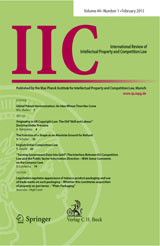
IIC - achtmal jährlich aktuell mit Archivbestand ab Erscheinen 1970.
IIC ist die englischsprachige Zeitschrift zu gewerblichem Rechtsschutz und Urheberrecht.
Der internationale, aus renommierten Experten zusammengesetzte Beirat der IIC, Korrespondenten in zahlreichen Ländern sowie fachkundige Redakteure beobachten laufend die Entwicklungen auf diesem Rechtsgebiet; sie berichten auch über wichtige Gerichtsentscheidungen und kommentieren diese.


 Module suchen